
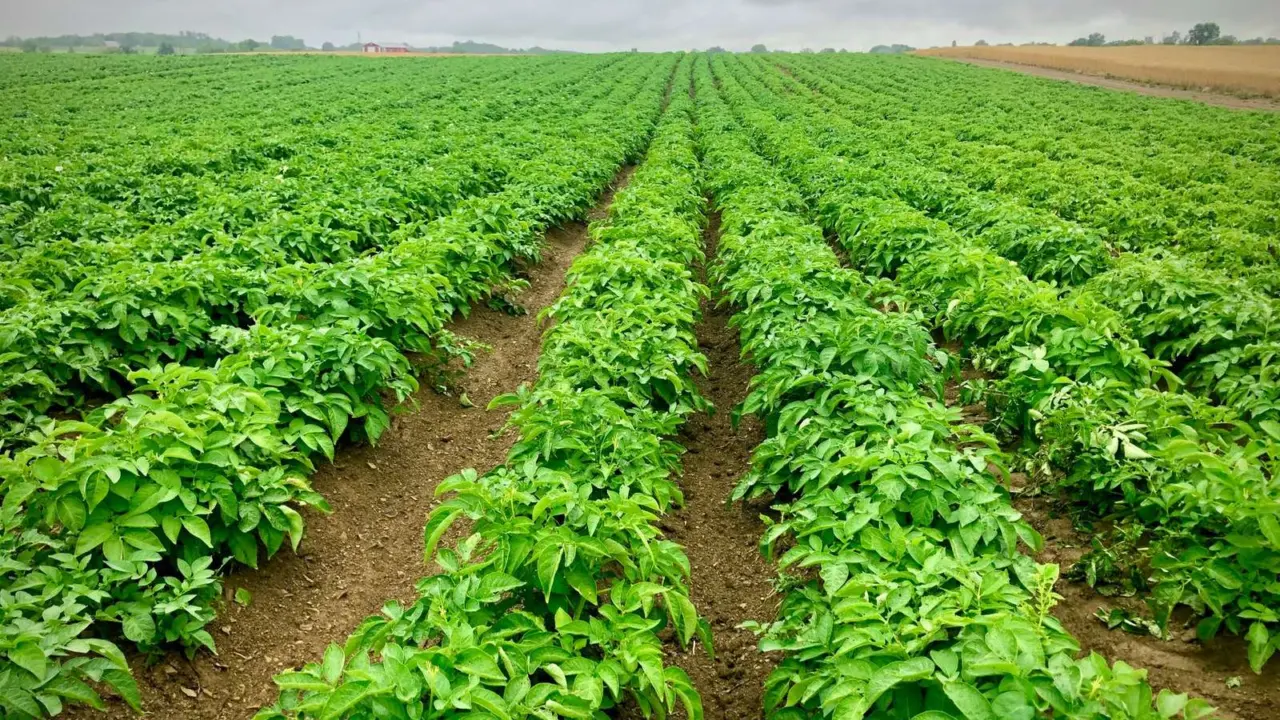
Wondering what is sustainable agriculture and whether it really differs from ordinary farming? It is farming that feeds people while protecting the soil, water and climate that future harvests depend on.
It is one practical strand of what is sustainability, applied to food.
| Item | Value |
|---|---|
| Share of global greenhouse gas emissions from food | Over a quarter (26%) |
| Share of habitable land used for agriculture | Half |
| Share of global freshwater withdrawals used for agriculture | 70% |
| Share of ocean and freshwater eutrophication linked to food | 78% |
| Soil health principles named by the NRCS | Four |
The environmental figures come from Our World in Data’s food and environment overview (published November 2019). The NRCS principle count comes from SARE’s cover crop guide. Figures can change as new data appears, so check the source before you rely on them.
What is sustainable agriculture in plain terms?
Sustainable agriculture treats a farm as a living system rather than a factory. The goal is to keep producing food over the long term without wearing out the resources that make production possible.
Most definitions rest on three legs: a farm that earns enough to continue, land and water that stay healthy, and a good life for farmers and their communities. Drop any one and the system stops being sustainable.
The term is not a single certification. It covers conventional, organic and mixed approaches, and what works depends heavily on local soil, climate and crops.
Why farming has such a large footprint
Food touches nearly every environmental problem. According to Our World in Data, food accounts for over a quarter (26%) of global greenhouse gas emissions, and half of the world’s habitable land is used for agriculture.
Water and pollution matter too. The same overview reports that 70% of global freshwater withdrawals are used for agriculture, and that food is linked to 78% of ocean and freshwater eutrophication, which is nutrient pollution of waterways.
Because the footprint is so large, small changes in how land is managed add up quickly.
Core practices that make it work
Sustainable farms rarely rely on one trick. They combine several practices that reinforce one another.
- Cover crops: plants grown between cash crops to protect and feed the soil.
- Crop rotation: alternating different crops to break pest cycles and balance nutrients.
- Reduced tillage: disturbing the soil less so its structure and life stay intact.
- Integrated pest management: monitoring pests and using targeted responses rather than routine spraying.
- Efficient water use: matching irrigation to what crops need.
- Integrating livestock: using grazing and manure to cycle nutrients.
No single item on this list defines sustainability. A farm that does all of them badly can still perform worse than one that does two or three well.
Soil health is the foundation
Healthy soil holds water, stores nutrients and supports a huge community of organisms. The US Natural Resources Conservation Service, as quoted by the SARE cover crop guide, identifies four main principles for soil health.
- Keep the soil covered as much as possible.
- Disturb the soil as little as possible.
- Keep plants growing throughout the year to feed the soil.
- Diversify crop rotations as much as possible, including with cover crops.
According to SARE’s cover crop book, cover crops were widely promoted in the Dust Bowl era to address soil erosion, which “remains a strong reason to use cover crops to this day.”
Living roots matter because they feed soil microbes. Over the long term those microbes become part of soil organic matter, which builds soil aggregates and gives the soil better structure.
Cover crops also change how farmers think about nutrients. The SARE guide says soil fertility used to be treated as an input-output model, particularly for nitrogen.
A more biological view asks how the soil itself can supply nutrients. That shift is the heart of the difference between feeding the crop and feeding the soil.
Legumes and the nitrogen story
The SARE guide says legumes are believed to have the longest history of use as cover crops, largely because they can fix nitrogen and so provide a key soil nutrient to other crops.
Before synthetic fertilizer became widespread after World War II, SARE notes, there were really only two common ways to replace nutrients removed by crops. Farmers either applied manure or grew a green manure legume crop in the rotation, such as alfalfa for hay or a clover cover crop.
That history matters because it shows sustainable agriculture is not a retreat to the past. It reuses old biological ideas, such as manure and legumes, and combines them with modern knowledge of soil biology and better equipment.
In practice, a farm using legumes might still buy some fertilizer. The aim is to rely on it less and to avoid applying it blindly.
How it connects to energy and waste
Farms use fuel, fertilizer and electricity, so cleaner energy lowers their footprint. Solar pumps, wind power and biogas are all options, and our guide to types of renewable energy explains how each works.
Waste is the other link. Crop residues, manure and food scraps can return to the soil as compost, a loop that mirrors the thinking behind what is a circular economy.
What it looks like on a real farm
A sustainable farm often looks less uniform than a conventional one. Fields may be green in seasons when neighbouring fields are bare, and different crops may follow one another from year to year.
The day-to-day routine usually includes a few habits:
- Planning rotations so that no field repeats the same crop too often.
- Choosing cover crop species for a specific goal, such as nitrogen or erosion control.
- Watching soil conditions before deciding on fertilizer or irrigation.
- Keeping records so that each change can be judged against results.
The SARE guide stresses that the right cover crop depends on a farm’s goals, so there is no single recipe to copy. That is why sustainable agriculture is described as site-specific.
It also helps to think in terms of years rather than months. Soil biology improves gradually, so a farmer who changes practices should expect to track results over several seasons.
Trade-offs and honest limits
Sustainable farming is not free of costs. Switching practices can need new equipment, new skills and a few seasons before soil benefits show up in yields or profits.
As a shopper or reader, treat vague labels with caution. Words like “natural” or “eco-friendly” on food packaging say little about how the land was actually managed.
Frequently asked questions
Is sustainable agriculture the same as organic farming?
Show answer
No. Organic is a defined certification with rules on inputs. Sustainable agriculture is a broader goal that can include organic, conventional and mixed systems.
Can sustainable farming feed everyone?
Show answer
This is debated, and the answer depends on the crops, region and practices involved. The sources used here do not settle it, so treat any confident claim with caution.
What is the simplest sustainable practice?
Show answer
Keeping soil covered is a common starting point.
How can I support sustainable agriculture as a consumer?
Show answer
Reduce food waste, buy seasonally where you can, and favor producers who explain how they manage soil and water.